CMDB Hygiene

Trust the Data in
Your CMDB.

Surf keeps your configuration data accurate, owned, and up to date — continuously, not just after the next audit.

The CMDB is only as useful as the data inside it. In most large enterprises, that data degrades constantly — owners leave, assets get created without records, duplicates accumulate. Teams discover the problem at the worst possible moment, when an incident is already in progress.

The workflow

How Surf works

From ownership gaps to consolidated records — Surf handles the operational layer your CMDB was never built to own.

01

Resolve ownership

Cross-referenced, confirmed, escalated

When a CI has no owner (unassigned, or the listed owner has left) or the owner on record is wrong, Surf cross-references cloud, IdP, and org chart data to identify the most likely correct owner, reaches out via Slack or Teams to confirm, and updates the record once validated. Unresolved cases escalate automatically through a customer-defined path: owner, manager, CMDB admin.
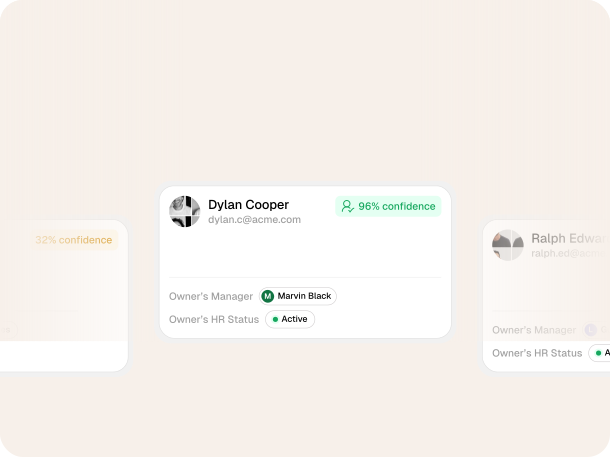
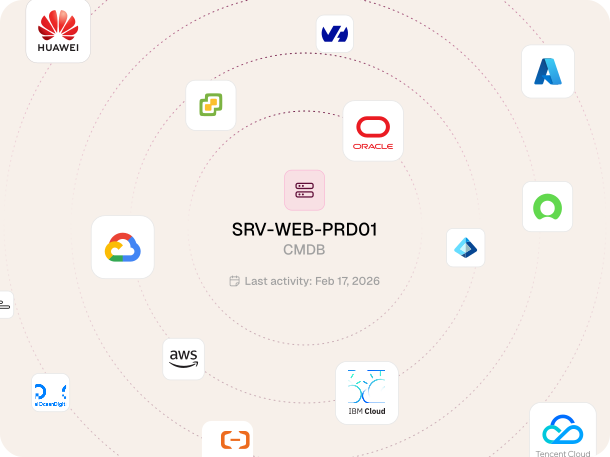
Ownership resolution view showing CMDB record vs. Context Graph resolution and escalation chain

02

Stale records cleaned up

Archived or confirmed before anything changes

Surf identifies CMDB entries tied to assets that no longer exist or have been dormant. Terminated resources are archived automatically. For underutilized ones, the owner is contacted to confirm before anything changes.

Stale asset view with archive status and owner confirmation log

03

Duplicates consolidated

Merged or archived with a full audit trail

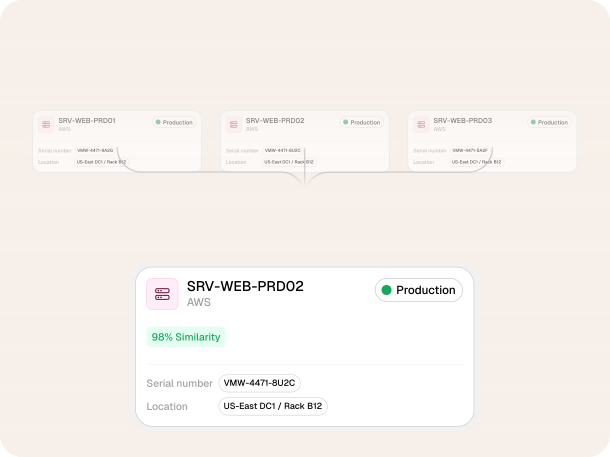
Surf detects CIs that appear to represent the same asset, contacts the owner, and merges or archives the duplicate based on their decision. Every consolidation is logged.

Duplicate detection view with merge or review options

The gap

Why existing tools fall short

CMDBs store data, they don't maintain it.

Today's ticketing systems such as ServiceNow and Jira Assets have no automated mechanism to detect when an owner leaves or a record goes stale nor do they have the ability to track down potential owners.

Periodic audits can't keep pace.

In a large, fast-moving environment, manual reviews always lag behind the rate of change.

No cross-platform context.

Without signals from IdP, IaaS, and HR systems, there's no reliable way to know who actually owns a resource or whether it still exists.

Stale data degrades everything downstream.

Incident response, change management, compliance — all of it depends on configuration data being accurate.

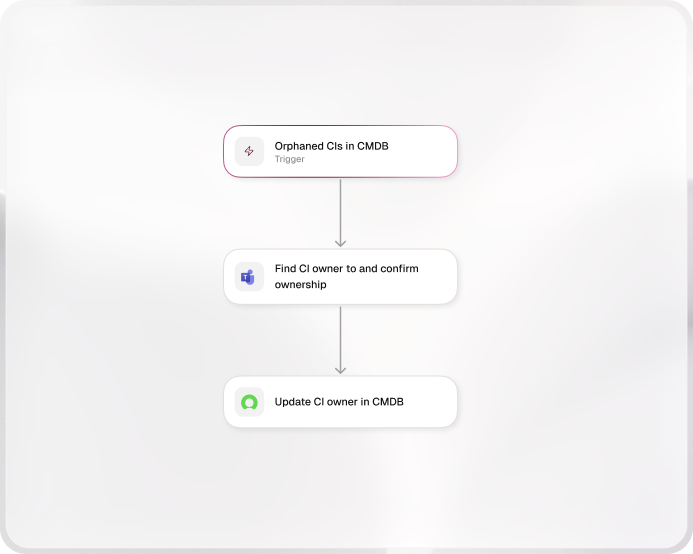
Surf CMDB hygiene workflow from ownership resolution through stale record cleanup and duplicate consolidation

What changes when Surf is in the loop

Continuous accuracy

CMDB hygiene maintained as a living workflow, not a periodic audit.

Audit-ready, always

Every CI reviewed, every ownership decision made, every record updated is logged.

More reliable change management

Dependency mapping and impact analysis require accurate asset data. Now they have it.

Faster reaction time

When something breaks, the right owner is reachable immediately.

CMDB Hygiene

See how Surf keeps your CMDB clean.

From ownership resolution to stale record cleanup and duplicate consolidation — with every decision logged.

Get a Demo