What is Agentic Security Operations? A Practical Definition


Security teams aren't flying blind. They have SIEMs. They have EDRs. They have posture management platforms surfacing hundreds of misconfigured resources every week. The alerts are running. The dashboards are full. The reports are comprehensive.
And yet, if you ask most CISOs how their remediation backlog looks, the answer is the same: growing. Known issues, unacted on. Teams that care deeply about fixing things, but lack the time, context, and coordination bandwidth to actually close them.
That's the gap that agentic security operations addresses.
Agentic security operations is the use of autonomous agents to execute multi-step security hygiene and remediation tasks end-to-end: connecting context across systems, identifying ownership, coordinating with stakeholders, and taking action with human approval at every step.
This piece explains what that means in practice, how it differs from what security teams already have, and what to look for when evaluating platforms in this space.
The Gap Between Detection and Action
Detection is largely solved. Not perfectly, but the industry has invested heavily in it for two decades, and it shows. Modern security tooling is remarkably good at finding problems.
But what happens next?
SOAR platforms were supposed to fix this. The pitch was compelling: automate the response side with playbooks and runbooks, the same way detection was automated with rules and signatures. And for well-defined, high-frequency scenarios, blocking an IP or resetting a compromised password, SOAR works.
But most real-world security hygiene work isn't well-defined. When a SIEM surfaces a dormant account with admin access, the immediate questions aren't technical. They're operational: Who owns this account? Is it attached to a service or process? What breaks if we disable it? Who needs to sign off? The answers live in five different systems, AD, HR, the CMDB, Slack, and someone's memory, and assembling them manually takes longer than most teams can afford to do consistently at scale.
The result is a backlog of known issues that never get resolved. Teams have the tooling to surface the problems, but lack the infrastructure to act on them.
What "Agentic" Actually Means in a Security Context
"Agentic" is already getting diluted, which is why a precise definition matters.
Adding a chatbot to a SIEM dashboard is not agentic. Having a language model summarize an alert is not agentic. Agentic means a system that completes multi-step tasks autonomously, across systems, with decision-making along the way. Four properties separate genuinely agentic systems from the noise:
- Multi-step execution
An agentic system doesn't just surface a finding and stop. It takes a chain of actions, discovery, investigation, stakeholder contact, execution, logging, without human hand-holding at each step. The handoffs happen automatically. The agent drives the workflow to completion. - Context-awareness
Security actions have dependencies. Disabling an account affects what it touches. Revoking a certificate affects what trusts it. An agentic system understands these relationships by pulling live context from across your environment: who owns the affected resource, what it connects to, what breaks if you change it. That's what makes safe execution possible. - Human-in-the-loop guardrails
Agentic doesn't mean unsupervised. The right model is: the agent assembles context and proposes action, and a human confirms before anything irreversible happens. Teams stay in control. The coordination overhead goes away. - Full auditability
Every action is logged: who approved it, when, what the system state was before and after, what downstream effects were detected. "The system did it" is not an acceptable audit response. An agentic platform gives you the complete record.
Agentic vs. SOAR vs. Scripted Automation
Capability | Scripted Automation | SOAR | Agentic Security Operations |
|---|---|---|---|
Handles pre-defined scenarios | Yes | Yes | Yes |
Works across multiple systems | Limited | Partial | Yes |
Identifies ownership dynamically | No | No | Yes |
Coordinates with stakeholders | No | Limited | Yes |
Handles novel / undefined issues | No | No | Yes |
Full audit trail | Limited | Partial | Yes |
SOAR's limitation isn't the platform. It's the assumption baked into the model. Runbooks assume you already know who the owner is. They assume the system state is predictable. They assume someone has written a script for this exact scenario. Most real-world security hygiene issues fail all three assumptions, which is why SOAR handles the top 20% of structured, high-frequency response tasks well and stalls everywhere else.
Scripted automation has the same problem but at a smaller scale. The scripts are brittle. They break when org structures change, when account types are added, when the ownership field in your CMDB turns out to be a service account from someone who left the company two years ago.
However, agentic systems don't require pre-defined structure. They reason over the context they find.
What Agentic Security Operations Looks Like in Practice
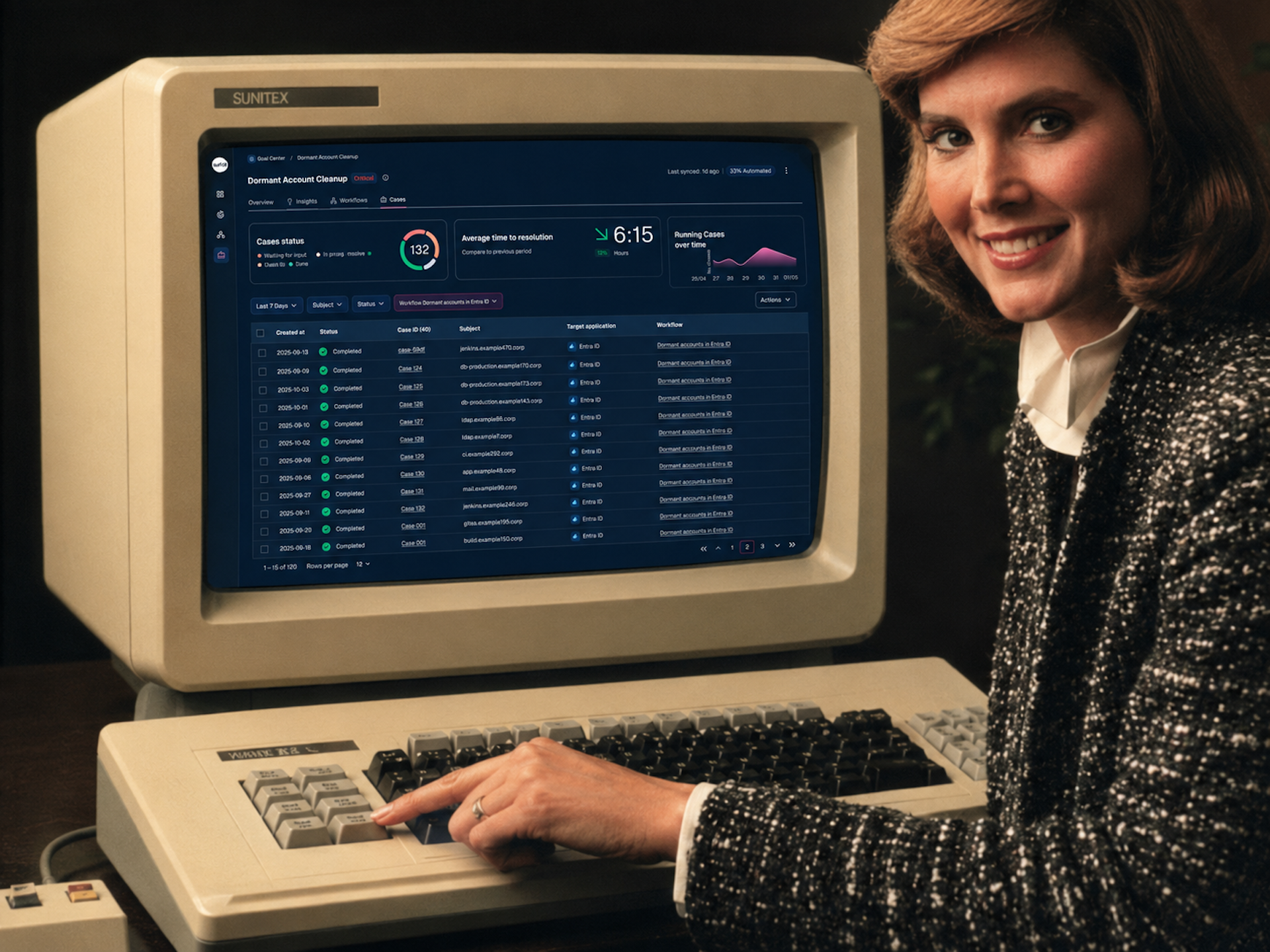
Abstract definitions only go so far. Here's what this actually looks like for one of the most common security hygiene problems: dormant account cleanup.
The agentic version:
- An agent scans your identity environment and surfaces 847 accounts with no login activity in 90 or more days
- It cross-references your HR system: 312 belong to active employees, 535 are flagged for review
- For each flagged account, the agent traces ownership, identifying the current manager and checking whether the account is tied to any running processes or integrations
- The agent sends targeted confirmation requests to each account owner: "This account hasn't been used in 90 days. We're planning to disable it. Does it need to stay active?"
- When an owner confirms it's safe to disable, or doesn't respond within the defined window, the agent disables the account, revokes associated tokens, updates the CMDB, and logs the full action with approver, timestamp, and outcome
- The complete audit trail is immediately available for compliance review
The manual version:
A security analyst exports a CSV of potentially dormant accounts. They email a manager. The manager isn't sure who owns some of them and forwards it to someone else. Three weeks later, a handful of accounts get disabled. Most sit in an inbox. The CSV goes stale. The next audit cycle starts the same conversation over again.
The agentic version allows way more scale of execution without scaling up the team.
What to Look for in an Agentic Security Platform
The gap between what vendors claim and what their systems do in production is significant. Here's what to stress-test:
Cross-system context: Can it connect identity, cloud, HR, and IT systems to surface ownership and dependencies in real time, not from a stale CMDB? The quality of the context is the quality of the agent's decisions.
End-to-end execution: Does it complete tasks, or does it surface them into a ticket queue for a human to act on? Surfacing tickets is better than nothing, but it's a smarter alert, not an agentic system.
Human approval workflows: Can confirmation requests be routed to the right stakeholder with full context, tracked, escalated on non-response, and logged? The approval layer is where most platforms cut corners.
Auditability: Is every action logged with timeline, approver identity, scope, and downstream impact? Ask to see what an audit export actually looks like before buying.
Rollback capability: What happens when the system does something unexpected? Every automated system eventually will. The question is whether the platform has a defined recovery path or whether you're on your own.
Frequently Asked Questions
What is the difference between agentic security and SOAR?
SOAR automates pre-defined response playbooks. It executes well-written scripts for known scenarios. Agentic security reasons over live context, identifies ownership dynamically, and handles situations that haven't been scripted in advance. SOAR requires someone to have anticipated the scenario. Agentic systems work without that prerequisite.
Does agentic security operations replace human analysts?
No. The model is human-in-the-loop. Agents handle the work of assembling context, routing to the right person, and executing once approved. Analysts still make the consequential decisions. They spend less time on coordination and more time on work that requires judgment.
What types of security tasks can agentic operations handle?
Any task that requires multi-step execution across systems: dormant account cleanup, post-termination access audits, certificate lifecycle management, NHI posture, overexposed data remediation, leaver access revocation. The common thread is tasks where the bottleneck isn't detection. It's coordination, ownership, and execution.
How is agentic security different from security automation?
Traditional security automation executes pre-defined scripts. Agentic security reasons over context, adapts when it encounters unexpected states, coordinates with stakeholders, and completes tasks end-to-end. Most real-world security hygiene problems don't fit neatly into a pre-written playbook. That's the gap it closes.
Surf AI is an agentic security operations platform built on these principles: connecting context across identity, cloud, HR, and IT systems so security teams can close the gap between finding issues and fixing them. See how the platform works.
Dylan is Head of Growth at Surf AI, with over a decade of experience in cybersecurity across Kroll, Avanan, and Beyond Identity.